
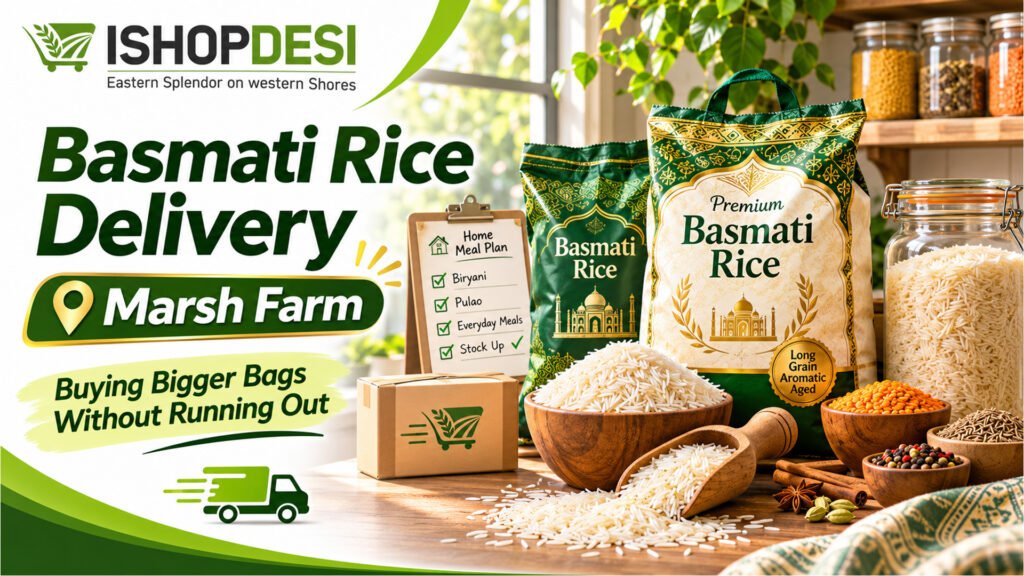
A large bag of basmati rice can seem like one of the most sensible purchases in a South Asian household.
You bring it home, place it in the kitchen cupboard and assume rice is one thing you won’t need to think about for a while.
Then, several weeks later, you lift the bag and discover there’s barely enough left for dinner.
Or the opposite happens.
You buy a 20kg bag because the price looks attractive, only to find that it occupies valuable cupboard space and will take much longer to finish than expected.
Both situations begin with the same problem: buying rice without understanding how much your household actually uses.
For families considering basmati rice delivery Marsh Farm, choosing the right bag size is not simply about finding the lowest price.
It involves knowing your consumption, comparing varieties, understanding storage requirements and deciding when another order makes sense.
A little practical planning can help you avoid both an empty rice container and an unnecessarily crowded kitchen.
Why Bigger Rice Bags Aren’t Always Better Value
Rice is a familiar pantry staple in many Indian, Pakistani and Bangladeshi households.
It appears in everyday meals such as daal chawal and accompanies curries, vegetable dishes and other preparations.
Biryani and pulao may also require substantial quantities, especially when cooking for guests.
For households that eat rice frequently, purchasing larger bags can be convenient.
However, convenience and value are not the same thing.
The Price Per Kilogram Matters
Imagine comparing three hypothetical rice products:
| Bag size | Example total price | Example price per kg |
|---|---|---|
| 5kg | £13.00 | £2.60 |
| 10kg | £24.00 | £2.40 |
| 20kg | £44.00 | £2.20 |
These figures are illustrative only, not verified IShopDesi prices.
In this example, the 20kg bag has the lowest unit price.
But whether it represents the best purchase depends on how quickly the household will use it.
If the rice remains in storage for a very long period, the apparent saving may become less meaningful.
Consider the Full Purchase Cost
When ordering online, check any applicable delivery charges and minimum order requirements.
A lower bag price doesn’t necessarily mean a lower total order cost.
Compare the complete transaction rather than the product price alone.
Don’t Buy More Than You Can Store
Large rice bags take up space.
They also require appropriate protection from moisture, pests and contamination.
If your kitchen lacks suitable storage, a smaller purchase may be more practical.
How Much Basmati Rice Does Your Household Actually Use?
One of the most useful things you can do before buying a large bag is estimate your real consumption.
You don’t need a complicated spreadsheet.
Start by thinking about how often rice appears in your meals.
The Difference Between Daily and Occasional Rice Cooking
A household preparing rice almost every evening may use significantly more than one that serves it twice a week.
The number of people eating also matters.
However, don’t assume that every family member consumes the same quantity.
Adults, children and people with different appetites may require different portions.
Use a Realistic Portion Estimate
For many adult meals, roughly 60–75g of uncooked rice per person can serve as an illustrative starting point.
Actual portions vary according to the dish, appetite and other foods served.
A rice-centred biryani may involve different quantities from rice accompanying several substantial side dishes.
Example: A Family of Four
Suppose four people each eat an average of 75g of uncooked rice at a particular meal.
That represents 300g for the household.
If rice is prepared four times a week, consumption would be approximately 1.2kg weekly.
At that rate, a 10kg bag would last around eight weeks, assuming no other rice use or waste.
This is only an example.
Your household’s actual consumption could be considerably higher or lower.
Measure Your Own Usage for Two Weeks
Instead of relying entirely on estimates, observe how much uncooked rice goes into the pot.
Record quantities for a short period.
You may discover that your household uses more rice on weekends or prepares larger quantities when relatives visit.
A small amount of observation can make future purchases much more accurate.
Choosing Between 5kg, 10kg and 20kg Rice Bags
The best bag size depends on consumption, storage space and how frequently you prefer to order groceries.
<text preserveWhitespace={true}> </text>
5kg: Useful for Smaller or Less Frequent Rice Consumption
A 5kg bag may suit someone who lives alone, cooks rice occasionally or wants to try a new variety.
It can also be practical when cupboard space is limited.
The unit price may be higher than a larger bag, but the lower total quantity can reduce unnecessary storage.
10kg: A Middle Ground for Many Households
A 10kg bag may suit a household that prepares rice regularly but doesn’t want to purchase a very large quantity at once.
It can offer a balance between storage requirements and buying frequency.
However, the right choice still depends on actual consumption.
20kg: Worth Considering for Frequent Rice Cooking
A 20kg bag may be suitable for a larger household or one that uses basmati rice very frequently.
The larger quantity can reduce the need for frequent purchases.
Before buying, check whether you have enough suitable storage space and can use the rice within its quality period.
Which Size Should You Choose?
| Household situation | Bag size worth considering | Why |
|---|---|---|
| Rice cooked occasionally | 5kg | Smaller quantity |
| Rice prepared several times weekly | 5kg or 10kg | Depends on servings |
| Large household with regular rice meals | 10kg or 20kg | May reduce ordering frequency |
| Trying an unfamiliar variety | Smaller pack first | Limits commitment |
| Limited dry-storage space | Smaller bag | Easier to accommodate |
These are practical considerations, not fixed purchasing rules.
For more information about varieties and pack selection, explore IShopDesi’s guide to buying basmati rice online in the UK.
The Rice Variety Matters as Much as the Bag Size
Not all basmati rice products behave identically.
Different varieties and processing methods influence texture, cooking requirements and the final dish.
Choosing the right quantity of the wrong rice won’t solve the problem.
Traditional White Basmati Rice
White basmati is widely used in South Asian cooking.
It is appreciated for its distinctive aroma and long-grain characteristics.
However, individual products vary in grain length, ageing and preparation requirements.
Sella Basmati Rice
Sella rice is parboiled before milling.
It can behave differently from regular white basmati during cooking.
Some home cooks prefer it for particular biryani or large-batch rice preparations.
Follow product-specific soaking and cooking instructions.
Brown Basmati Rice
Brown basmati retains more of its bran layer than white basmati.
Its texture and cooking requirements differ.
It generally requires a different preparation method from white basmati.
Aged Basmati Rice
Some basmati products are marketed as aged.
Ageing can influence cooking characteristics, but quality depends on more than an age claim.
Check the product description and follow its preparation instructions.
For a broader comparison, IShopDesi’s article on basmati rice varieties for Luton households provides additional guidance.
Buying Rice for Daal Chawal, Biryani and Pulao
One of the reasons basmati is a familiar household staple is its use in different dishes.
But preparation methods vary considerably.
Everyday Daal Chawal
Daal chawal can be a straightforward meal when the lentils and rice are prepared appropriately.
Rice texture is largely a matter of recipe and household preference.
Some people enjoy separate, fluffy grains.
Others prefer a softer preparation alongside daal.
The choice should reflect the way your family eats.
For information about lentil varieties, see IShopDesi’s guide to daal online in Luton.
Biryani for Family Gatherings
Biryani can require more careful rice preparation.
Some recipes involve partially cooking the rice before layering it with other ingredients.
Overcooking the rice at an early stage can affect the finished texture.
Follow a reliable recipe that specifies the intended rice variety and method.
Pulao with Meat or Vegetables
Pulao often involves cooking rice with seasoned liquid and other ingredients.
The amount of liquid and the stage at which rice is added can affect the result.
If the dish contains meat, the recipe may require the meat to reach an appropriate cooking stage before the rice is introduced.
For related meal ideas, explore IShopDesi’s article on basmati rice dishes for Farley Hill homes.
A Simple Rice Stock-Level System That Actually Works
Running out of rice usually doesn’t happen because people forget that rice exists.
It happens because the remaining quantity is difficult to judge.
A partly folded bag in the corner of a cupboard rarely provides an accurate picture of how many meals are left.
A more useful approach is to set a clear point at which you check stock.
Step One: Identify Your Normal Weekly Use
Use your household’s approximate rice consumption.
For example, if you regularly use 1kg each week, you have a useful starting point.
Step Two: Choose a Reorder Level
Decide how much rice you prefer to have remaining before placing another order.
This should account for your cooking routine, storage capacity and the retailer’s currently available delivery arrangements.
Avoid assuming a guaranteed delivery timeframe.
Step Three: Use a Visible Storage Container
Where appropriate, a transparent, food-safe container can make the remaining quantity easier to see.
If you prefer keeping rice in its original bag, consider a consistent way of checking the contents.
Step Four: Review Before Major Family Meals
If you’re planning a biryani or pulao for guests, check the rice quantity separately.
A larger meal can change your usual consumption pattern.
Step Five: Adjust the System When Habits Change
If household members begin eating more rice, your reorder point may need to change.
The objective is to reflect actual consumption rather than follow an arbitrary schedule.
How to Store Large Basmati Rice Bags Properly
Rice is a dry pantry product, but it still needs suitable storage.
Moisture, pests and contamination can affect quality and safety.
A large bag deserves particular attention because it may remain in the home for an extended period.
Choose a Cool, Dry Storage Area
Follow the manufacturer’s storage instructions.
Avoid areas exposed to moisture or significant temperature fluctuations.
Keep rice away from cleaning products and other potential sources of contamination.
Use Suitable Food-Safe Containers
A clean, dry, food-safe container with a secure lid can help protect rice.
The container should be appropriate for the quantity stored.
Avoid transferring rice into containers that previously held non-food substances.
Keep Product Information
If you remove rice from its original packaging, retain the product name, relevant dates and preparation instructions.
This is especially useful when you buy different varieties.
Don’t Mix New Rice with Old Rice Automatically
Combining the remaining rice from an older packet with a new bag may make date tracking difficult.
It can also create problems if the older product has deteriorated.
Check the older rice carefully and use an appropriate stock-rotation method.
Watch for Signs of Damage
If rice shows evidence of insects, moisture damage, mould or unusual odours, assess it carefully and discard unsafe products.
Cooking does not make contaminated or spoiled rice automatically safe.
Does Buying Bigger Bags Always Save Money?
The answer depends on more than the advertised price.
Consider three separate factors.
1. Unit Price
Compare the cost per kilogram.
This shows whether the larger bag offers a lower price for the same quantity.
2. Total Spending
A 20kg bag might provide a lower unit price but require a larger payment at once.
Some households may prefer smaller purchases that fit their current budget.
3. Usable Quantity
If a product deteriorates or remains unused, its apparent saving can disappear.
Value should be judged by the amount of suitable rice the household actually consumes.
For families comparing bulk basmati rice online UK, all three factors deserve attention.
A larger bag is useful when it matches the household’s requirements.
It isn’t a better purchase simply because it is larger.
Common Mistakes When Ordering Rice Online
Online shopping allows you to compare product details before checkout.
However, similar-looking rice bags can create confusion.
Mistake One: Comparing Different Rice Types as Though They Are Identical
A bag of sella basmati and a bag of regular white basmati may have different cooking characteristics.
Better approach: Compare products of the same variety when evaluating price.
Mistake Two: Looking Only at the Product Photograph
Packaging can change, and photographs may not explain the precise rice characteristics.
Better approach: Read the full title, weight and product description.
Mistake Three: Ignoring Storage Space
A large bag may be inconvenient in a small kitchen.
Better approach: Check the dimensions and available storage before ordering.
Mistake Four: Assuming the Biggest Bag Has the Best Price
Retail promotions and unit prices vary.
Better approach: Calculate or compare the price per kilogram.
Mistake Five: Waiting Until the Rice Is Completely Finished
If rice is needed for an upcoming meal, discovering an empty container can disrupt plans.
Better approach: Maintain a reorder level that suits your household and current delivery options.
Cooking Rice Correctly Helps Avoid Unnecessary Waste
Buying the right amount is useful, but preparing it properly also matters.
Poor cooking can leave rice unsuitable for the intended dish.
Measure Before Cooking
Use quantities suited to the recipe and number of diners.
Avoid adding extra rice simply because it appears dry or compact in the measuring cup.
Follow Soaking Instructions
Some rice recipes recommend soaking.
Others use different methods.
Soaking time can depend on the variety and intended preparation.
Use the Correct Water Ratio
Rice varieties and cooking methods require different liquid quantities.
A method that works for one product may not produce the same result with another.
Avoid Repeated Guesswork
If you regularly cook the same brand and variety, take note of the preparation method that works well.
A consistent approach makes results more predictable.
For more detailed rice preparation ideas, IShopDesi’s article on how to cook biryani with authentic ingredients discusses ingredient choices for traditional rice cooking.
Food Safety: Cooked Rice Needs Special Attention
Uncooked rice and cooked rice have different storage requirements.
Cooked rice can present a food-safety risk if cooled or stored incorrectly.
Bacillus cereus spores may survive cooking, and harmful bacterial growth or toxin production can occur under unsuitable conditions.
Cool Cooked Rice Promptly
Follow current UK Food Standards Agency guidance.
Rice intended for later use should be cooled quickly, ideally within one hour, and placed in the refrigerator.
Refrigerate Appropriately
Keep cooked rice refrigerated at a suitable temperature.
The Food Standards Agency advises eating refrigerated rice within 24 hours.
Reheat Only Once
When reheating rice, ensure it is steaming hot throughout.
Avoid repeatedly reheating the same batch.
Don’t Assume Smell Reveals the Risk
Rice associated with food poisoning may not show obvious signs of spoilage.
Appropriate cooling and storage are essential.
This is another reason to cook realistic quantities rather than preparing excessive amounts automatically.
What Should Marsh Farm Households Check Before Ordering Basmati Rice?
For people researching buy basmati rice online Marsh Farm, choosing an appropriate product involves several practical details.
Confirm the Rice Variety
Check whether the listing refers to white basmati, sella, brown basmati or another variety.
Review the Weight
Compare 5kg, 10kg and 20kg options where available.
Don’t assume every brand offers identical pack sizes.
Compare Prices Fairly
Look at the unit price and any applicable delivery charges.
Read Storage and Preparation Information
A product should be suitable for the meals you intend to prepare.
Check Availability and Delivery Eligibility
Before purchasing, confirm whether the retailer currently serves your specific Marsh Farm postcode.
Review available delivery options and minimum order requirements.
For broader guidance on shopping for South Asian staples, IShopDesi’s article on Asian grocery pantry essentials in Luton explains common ingredients used in everyday cooking.
How IShopDesi Can Support Rice Shopping in Marsh Farm
For households considering basmati rice online Luton, an online grocery platform can provide a way to compare available varieties and pack sizes.
IShopDesi offers online access to South Asian grocery categories and familiar cooking essentials.
Customers can explore current product listings and review the rice options that match their household’s preferences.
For a related local shopping perspective, IShopDesi’s article on halal meat order planning in Marsh Farm discusses another aspect of organising ingredients for family meals.
The most useful online rice order is one built around three questions:
- Will this rice work for the dishes we usually cook?
- Can we realistically use and store the quantity?
- Does the total purchase represent reasonable value?
Check current product availability, pricing, delivery charges and postcode eligibility before checkout.
The goal is to keep suitable rice available without purchasing more than the household needs.
Frequently Asked Questions
Is a 20kg basmati rice bag better value than a 5kg bag?
It may have a lower price per kilogram, but the best choice depends on household consumption, storage space and the complete purchase cost.
How much uncooked basmati rice should I prepare per person?
Around 60–75g can be an illustrative starting point for many adult meals, but portions vary according to the dish and individual appetite.
How long will a 10kg bag of basmati rice last?
That depends on consumption. A household using approximately 1kg weekly would use 10kg in around ten weeks.
What is the difference between white basmati and sella rice?
Sella rice undergoes parboiling before milling, which changes its cooking characteristics. Follow the product-specific instructions.
Is aged basmati rice always better?
Not necessarily. Ageing may influence cooking properties, but suitability depends on the product and intended dish.
How should I store a large bag of basmati rice?
Follow the packaging instructions and protect the rice from moisture, pests and contamination. Suitable food-safe containers may help.
Can I mix different basmati rice varieties?
It is possible, but different varieties may require different cooking times and liquid quantities, making results less predictable.
How can I stop running out of rice unexpectedly?
Monitor household consumption and choose a reorder level that reflects your cooking habits and currently available delivery arrangements.
Can cooked rice be kept for the next day?
Yes, if handled safely. Follow current UK food-safety guidance, cool it promptly, refrigerate appropriately and use it within the recommended period.
Can I order large basmati rice bags online in Marsh Farm, Luton?
You can explore online South Asian grocery retailers such as IShopDesi. Confirm the available bag sizes, current stock and delivery eligibility for your postcode.
Conclusion: Buy Enough Rice, Not Simply the Biggest Bag
A large basmati rice bag can be a sensible household purchase.
But it only becomes genuinely useful when the quantity matches the way your family cooks.
A 5kg bag may be practical for occasional rice meals. A 10kg bag could offer a useful balance for regular cooking. A 20kg bag may suit households with higher consumption and suitable storage.
None is automatically the best choice.
The right decision comes from understanding the rice variety, the meals you prepare, the available storage space and the total purchase cost.
For Marsh Farm households, online grocery shopping can offer another way to compare basmati rice options when suitable products and delivery services are available.
Choose the grain you enjoy, buy a quantity you can manage and establish a simple routine for checking what remains.
That way, the rice cupboard supports your cooking instead of creating another last-minute problem.