When halal meat arrives at home, the order is not finished yet. The next few minutes matter because that is when the kitchen routine begins: what will be cooked first, what should be chilled, what needs portioning, and what should go into the freezer for another day.
Many families order chicken, lamb, mutton, mince, kebabs, or curry cuts with good intentions, but the meat can become harder to manage if it is placed in the fridge without a plan. A better approach is to sort it by meal, label it clearly, and connect it with the groceries that will help turn it into dinner later.
This guide explains how to store halal meat after delivery in a simple, family-friendly way so your kitchen stays organised, meals are easier to plan, and fresh meat is used with less waste.
Why Meat Storage Matters After Online Delivery
Fresh meat should be handled properly once it reaches the kitchen. Chicken, mince, lamb, mutton, and kebabs all need attention because they are used in different dishes and may not all be cooked on the same day.
Good halal meat storage tips are not only about keeping meat cold. They are also about making the week easier. When each pack has a purpose, families can cook with less confusion.
A useful storage routine helps you:
- Keep same-day meat separate
- Freeze extra portions before they are forgotten
- Avoid opening large packs again and again
- Match meat with planned dishes
- Reduce last-minute dinner stress
- Keep the fridge and freezer easier to manage
The main idea is simple: do not put meat away randomly. Sort it before the kitchen gets busy.
First Step: Check the Meat Order Before Putting It Away
Before storing anything, take a moment to review what has arrived. Check whether the order includes chicken, mince, lamb, mutton, kebabs, curry cuts, whole chicken, or any ready-to-cook items.
With fresh halal meat delivery, this first check helps families decide what belongs in the fridge and what should be frozen.
Ask yourself:
- Which meat will be cooked today?
- Which pack is for tomorrow?
- Which items are for weekend meals?
- Which portions should be frozen?
- Does any pack need to be divided?
- Are the groceries for each meal already available?
This small review makes the rest of the storage process easier.
Store Same-Day Meat Separately
If meat is being cooked the same day, keep it separate from the items that will be frozen. This prevents confusion and makes cooking smoother later.
For example, chicken planned for curry can stay ready for that meal. Mince planned for keema can be kept apart from mince that will be frozen. Lamb or mutton for a slower dish should be clearly identified so nobody accidentally stores it with quick-use items.
When handling halal meat after delivery, same-day planning is helpful because it tells the family what needs attention first.
A simple habit is to create three groups:
- Cook today
- Cook soon
- Freeze for later
This works better than placing everything into the fridge and deciding later.
Refrigerating Halal Meat for Short-Term Use
If meat will be used soon, it should be kept chilled and away from foods that are ready to eat. Raw meat should be stored carefully so it does not touch salads, fruit, cooked food, snacks, or drinks.
When you store halal meat in fridge, keep each type in its own sealed pack or container. If the packaging is already secure, keep it closed until cooking time. If a pack has been opened, cover it properly and use it according to your cooking plan.
Short-term fridge storage works best when:
- Same-day meat is easy to identify
- Raw meat stays separate from ready foods
- Packs are not left open
- Meat is not moved around too often
- The family knows which pack should be cooked first
A neat fridge saves time when dinner starts.
Freezing Halal Meat for Later Meals
Freezing is useful when meat will not be cooked immediately. The mistake many families make is freezing one large pack without dividing it. Later, the whole pack has to be thawed even if only a small amount is needed.
It is better to freeze halal meat properly by portioning it according to meals.
For example:
- Chicken for curry
- Mince for keema
- Lamb for salan
- Mutton for weekend cooking
- Meat pieces for biryani
- Boneless chicken for wraps
- Kebabs for quick meals
Meal-based portions make future cooking easier because each pack already has a purpose.
How to Store Halal Chicken After Delivery
Chicken is often used for faster meals, so it should be sorted based on the dish. Curry cuts, boneless chicken, wings, drumsticks, and whole chicken all need different planning.
With halal chicken storage, families can divide chicken into portions for salan, karahi, biryani, wraps, rice bowls, soup, or roast-style meals.
Curry cuts can be kept for family dinners. Boneless chicken can be portioned for quick meals. Wings and drumsticks can be saved for oven-style or snack-style cooking. Whole chicken can be used for a larger meal, biryani preparation, stock, or soup.
For chicken meal planning, read Halal Chicken Delivery Luton.
How to Store Halal Mince After Delivery
Mince should be sorted early because it is easy to use but also easy to forget if it is placed in the freezer without a plan.
With halal mince storage, divide mince into smaller portions for keema, kofta, paratha rolls, rice bowls, or lunch fillings.
A useful method is to label each mince pack by meal idea:
- Keema dinner
- Kofta curry
- Paratha roll filling
- Rice bowl mince
- Freezer backup
This way, the family does not have to guess later.
For mince meal ideas, visit Halal Minced Beef Delivery Luton.
How to Store Lamb and Mutton After Delivery
Lamb and mutton are often used for richer meals, weekend dishes, slow cooking, guests, biryani, pulao, or salan. These meats usually need more planning than quick chicken or mince meals.
Good halal lamb storage starts with deciding how the meat will be cooked. Bone-in lamb may be saved for curry or deeper flavour dishes. Boneless lamb can be easier to serve. Mutton can be portioned for slow-cooked meals or guest dinners.
Lamb and mutton portions should be labelled clearly so the family knows which pack is for biryani, which is for salan, and which is saved for weekend cooking.
For lamb basket planning, read Halal Lamb Delivery Luton.
The Meal-Based Portioning Method
The easiest storage system is to portion meat by dish. This helps families cook faster because each pack already matches a meal.
Chicken Curry Pack
This pack may include chicken planned for curry, with onions, tomatoes, spices, rice, or roti support checked separately.
Keema Pack
This pack may include mince planned for keema, with tomatoes, green chillies, coriander, and paratha or rice support in mind.
Biryani Pack
This pack may include chicken, lamb, or mutton planned for biryani, with rice, yogurt, mint, coriander, and whole spices checked before cooking day.
Weekend Salan Pack
This pack may include lamb or mutton for slower cooking, family meals, or guests.
Quick Dinner Pack
This pack may include boneless chicken, mince, or kebabs for a faster meal when the day is busy.
This method turns meat storage into meal preparation.
Where Desi Grocery Delivery Fits into Meat Storage Planning
Stored meat is only useful when the rest of the kitchen is ready. A freezer full of chicken, lamb, mutton, or mince does not help much if rice, spices, onions, tomatoes, yogurt, or herbs are missing.
That is where Desi grocery delivery Luton fits into the storage routine. Families can plan meat along with rice, atta, spices, fresh vegetables, chutneys, yogurt, frozen paratha, and pantry items.
If chicken is stored for curry, check curry spices and fresh ingredients. If mince is stored for keema, check onions, tomatoes, green chillies, coriander, and paratha. If lamb is stored for biryani, check basmati rice, yogurt, mint, and whole spices.
A stored meat pack should have a meal plan waiting for it.
Fresh Ingredients to Check Before Storing Meat
Fresh ingredients help turn stored meat into real meals later. If the meat is ready but the fresh base is missing, cooking still becomes delayed.
Useful fresh ingredients for halal meat may include:
- Onions
- Tomatoes
- Garlic
- Ginger
- Coriander
- Mint
- Green chillies
- Lemon
- Cucumber
- Potatoes
- Salad items
For fresh produce support, visit Fresh Vegetables Online Luton.
These ingredients should be checked when meat is stored, not only when cooking begins.
Spices and Pantry Items to Keep Ready with Stored Meat
Meat storage works better when the spice shelf and pantry are also prepared. Otherwise, families may have meat ready but no way to cook it properly.
Good halal meat meal planning includes checking:
- Turmeric
- Red chilli powder
- Cumin
- Coriander powder
- Garam masala
- Biryani masala
- Curry masala
- Whole spices
- Cooking oil
- Basmati rice
- Atta
- Daal
- Yogurt
- Chutneys and pickles
For spices, read Pakistani Spices Online UK.
For rice planning, visit Basmati Rice Delivery Luton.
A good freezer plan needs good pantry support.
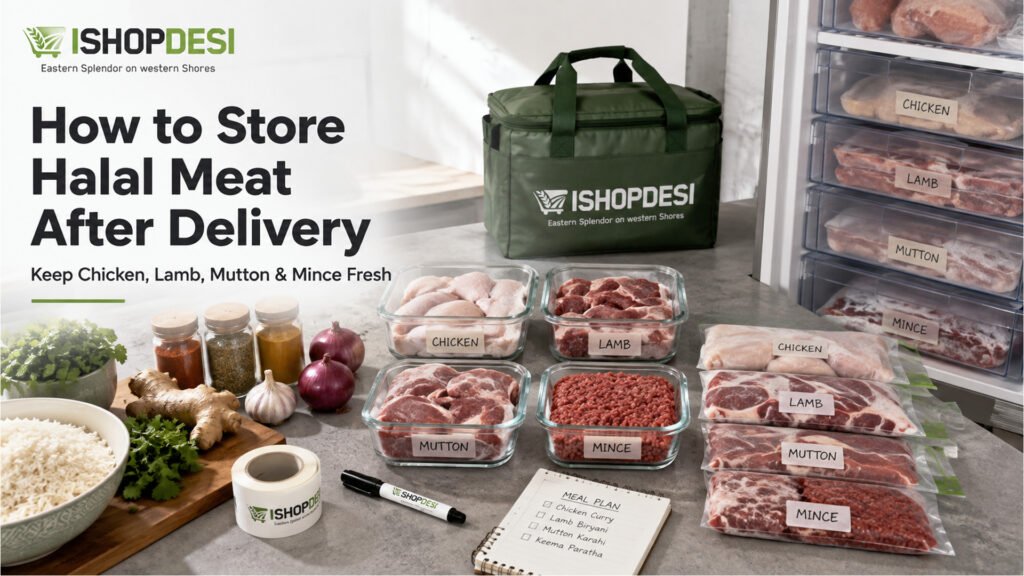
Simple Labelling Tips for Fridge and Freezer Packs
Labels may look like a small step, but they make a big difference. Without labels, frozen packs can become confusing after a few days.
With freezer labelling for meat, families can quickly see what each pack is and what it was saved for.
A useful label can include:
- Meat type
- Date stored
- Planned meal
- Portion size
- “Use first” note if needed
Examples:
- Chicken curry pack
- Mince for keema
- Lamb biryani portion
- Mutton weekend salan
- Kebabs for rolls
Labels help the whole family understand the freezer, not just the person who stored the food.
Common Mistakes When Storing Halal Meat
Small storage mistakes can make weekly cooking harder.
Leaving Meat Unsorted After Delivery
When all meat is placed in the fridge together, it becomes harder to remember which pack was meant for which meal.
Freezing Large Packs Without Portions
Large frozen packs are difficult to use when only one meal amount is needed. Portioning before freezing saves time later.
Forgetting Labels
Unlabelled packs can lead to confusion, wasted food, or repeated buying.
Mixing Raw Meat with Ready-to-Eat Items
Raw meat should be kept away from foods that are already cooked or ready to serve.
Ordering Meat Without Checking Meal Support
Rice, spices, vegetables, yogurt, herbs, and sides should be planned with the meat.
A Simple Checklist After Halal Meat Delivery Arrives
Use this quick checklist for how to store halal meat after your order reaches home.
- Check the full order
- Separate chicken, lamb, mutton, mince, and kebabs
- Decide what will be cooked today
- Keep same-day meat separate
- Portion extra meat by meal
- Label freezer packs clearly
- Store raw meat away from ready foods
- Check fridge and freezer space
- Keep older frozen packs near the front
- Check rice, spices, and fresh ingredients
- Plan which pack should be used first
This checklist helps families move from delivery to organised meal planning.
How IShopDesi Helps with Halal Meat and Grocery Planning
IShopDesi helps families plan halal meat along with the groceries that make meals complete. Instead of ordering meat alone, shoppers can think about the full basket before checkout.
With IShopDesi halal meat delivery, families can plan chicken, mince, lamb, mutton, rice, spices, fresh vegetables, frozen foods, chutneys, yogurt, and pantry support in one routine.
This makes storage easier too because each meat pack can be linked to a meal idea before it goes into the fridge or freezer.
A better grocery order does not end at the doorstep. It continues into how the kitchen is organised after delivery.
Helpful IShopDesi Guides for Meat and Meal Planning
For wider meat ordering support, read Halal Meat Delivery Luton.
For chicken storage and meal ideas, visit Halal Chicken Delivery Luton.
For mince planning, use Halal Minced Beef Delivery Luton.
For lamb meal support, read Halal Lamb Delivery Luton.
For pantry and desi grocery support, visit Desi Grocery Delivery Luton.
For fresh ingredients, see Fresh Vegetables Online Luton.
For spice planning, explore Pakistani Spices Online UK.
For freezer-friendly planning, read Frozen Halal Food Delivery.
FAQs About Storing Halal Meat After Delivery
What should I do first after halal meat is delivered?
Check the order, separate meat by type, decide what will be cooked first, and store the rest properly in the fridge or freezer.
Should halal meat be portioned before freezing?
Yes, portioning before freezing makes it easier to thaw only what is needed for one meal.
How should I store halal chicken after delivery?
Separate chicken by dish idea, such as curry, biryani, wraps, or rice bowls. Keep same-day chicken chilled and freeze extra portions if needed.
How can I store halal mince for quick meals?
Divide mince into smaller packs for keema, kofta, rolls, or rice bowls. Label each pack before freezing.
What should I check before freezing lamb or mutton?
Check the planned dish, portion size, cooking time, rice or roti support, spices, fresh herbs, and freezer space.
How does IShopDesi help with halal meat and grocery planning?
IShopDesi helps families shop halal meat with supporting groceries such as rice, spices, fresh vegetables, frozen foods, chutneys, yogurt, and pantry basics.
Conclusion: Better Storage Makes Halal Meat More Useful
Halal meat delivery becomes more helpful when the kitchen has a storage plan. Chicken, lamb, mutton, mince, and kebabs should not be placed away without thinking. Each pack should have a purpose, whether it is for same-day cooking, a weekend meal, freezer backup, or a quick dinner.
Good storage means sorting meat early, keeping raw items separate, portioning properly, labelling packs, checking freezer space, and planning the groceries that complete each meal.
A well-stored meat order does more than stay fresh. It helps the whole week feel easier to cook through.